Funding and access
Paying for Trexo Theo: insurance, Medicaid and other funding
For US families exploring Trexo Theo. How insurance, Medicaid and other funding work for a prescription device like Theo, what to ask at each step, and the letters and checklists to use.
1. Start here
Finding a way to pay can take work. This guide helps you ask the right questions, build a clear request and keep track of decisions. Coverage is not guaranteed. A prescription, FDA clearance or a helpful trial does not, by itself, mean a plan will pay.
Trexo Theo is a prescription powered exoskeleton. The FDA cleared Theo on September 2, 2026, under 510(k) K254198. Your child's doctor decides whether Theo is appropriate.
Read the full Indications for Use and safety information with your child's doctor. This guide does not decide whether Theo is right for an individual.
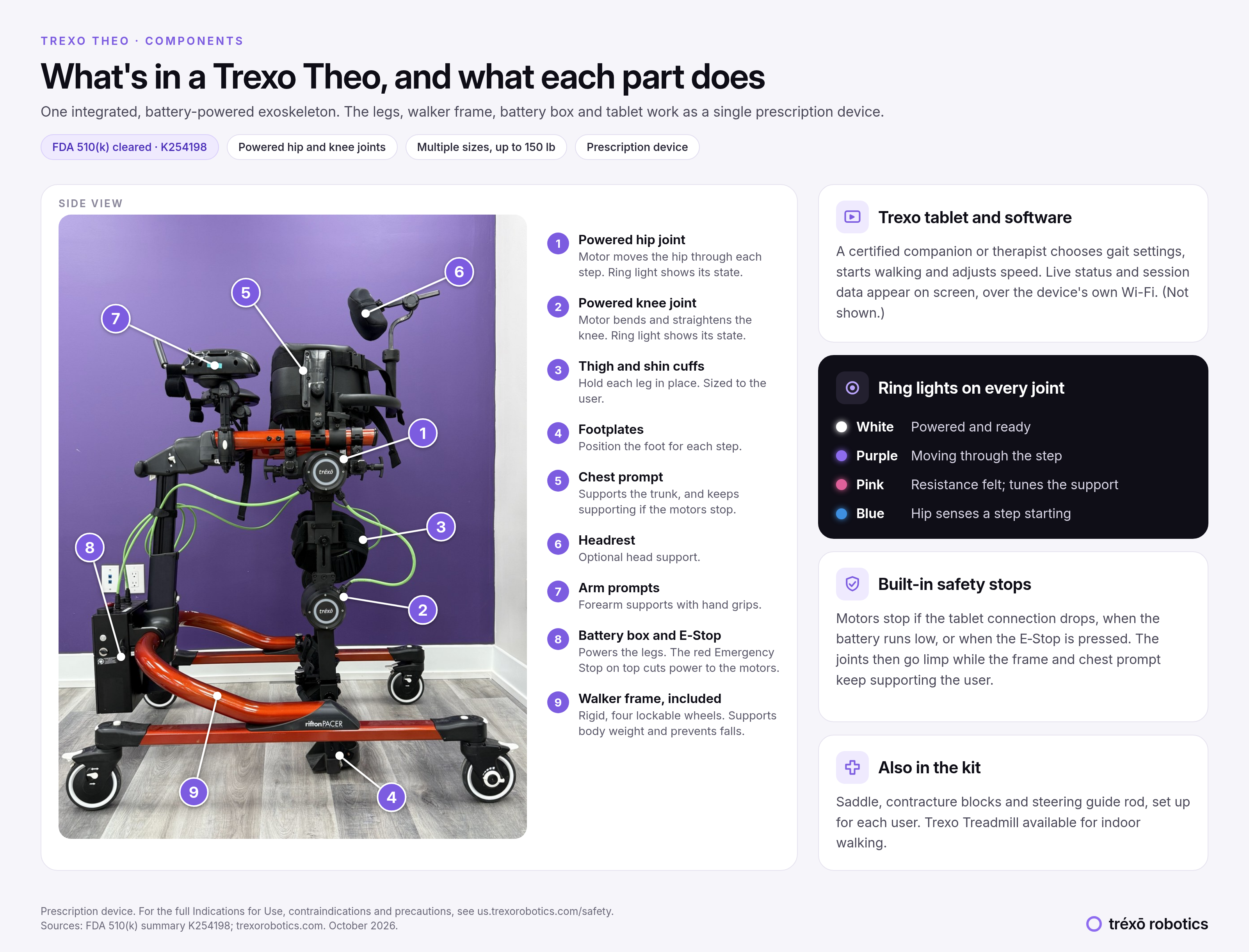
Theo is one integrated device, including its support frame. The frame is not a separate purchase or separate billing request within this guide.
This is the detailed companion to the Trexo US funding page. The same four broad ways to pay apply: insurance and Medicaid, foundations and grants, fundraising, and clinic and school programs.
Sources for this section
2. Choose your path
Most families use more than one of these at the same time.
- If you have employer or private insurance: Ask your plan for its policy and equipment benefit rules, then start with Chapter 3.
- If you have Medicaid or CHIP: Ask the number on your card which program you have and who handles equipment requests, then start with Chapter 4.
- If you have a state program or waiver: Ask your case manager for your program's equipment rules, then explore Chapter 5.
- If you have TRICARE: Ask your regional contractor or case manager about equipment benefits, then go to the Chapter 5 military section.
- If you have no coverage or are not sure: Explore Chapter 5 and book a free consultation with Advocacy Abby for grants and fundraising help.
Words you will see
-
NPI (National Provider Identifier): the identification number of the clinician who writes the prescription.
-
PT or OT: physical therapist or occupational therapist. A PT or OT assessment is their written report about how your child moves and what support your child needs.
-
HR (Human Resources): Your employer's human resources or benefits office.
-
Grandfathered plan: A health plan that has kept a special status dating from March 23, 2010, so some Affordable Care Act requirements do not apply.
-
CHIP (Children's Health Insurance Program): A state-run program offering low-cost health coverage to eligible children whose families earn too much for Medicaid.
-
EPSDT (Early and Periodic Screening, Diagnostic and Treatment): Medicaid's comprehensive screening, diagnosis and treatment benefit for eligible people under 21.
-
Prior authorization: Approval your health plan may require before you receive an item or service, which is not a guarantee of payment.
-
Deductible: The amount you pay for covered care before your plan starts paying for services subject to that deductible.
-
Coinsurance: The percentage of a covered item's or service's allowed amount that you pay, usually after meeting your deductible.
-
Allowed amount: The amount your plan recognizes for a covered item or service when calculating what it and you pay.
-
Network: The providers and suppliers that have contracts with your health plan.
-
Network-gap exception: A plan-approved arrangement to use an out-of-network provider or supplier at in-network benefit terms when a suitable network option is unavailable.
-
DME (Durable Medical Equipment): Medical equipment ordered by a health care provider for repeated or extended use.
-
LMN (Letter of Medical Necessity): A letter from your clinician explaining why a requested item or service is medically needed for you.
-
External review: An independent reviewer outside your health plan checks an eligible denial under the applicable review process.
3. Private insurance, step by step
Step 1: Find the actual rules
Request the Summary Plan Description, if applicable, the full plan or insurance policy, Summary of Benefits and Coverage, equipment and orthotic benefits, and appeal procedures. Look for durable medical equipment (DME), orthotics, powered exoskeletons, medical necessity, investigational care, exclusions, rental limits and network rules. Ask which benefit applies to the exact Theo request. A policy for an ordinary gait trainer does not establish coverage for a powered exoskeleton.
Know your plan type: Ask HR or the plan administrator: "Is this plan fully insured or self-funded? Who is the legal plan administrator? Is it subject to ERISA, and is it grandfathered?" Fully insured means an insurance company pays claims; self-funded means the employer pays them, even if an insurer's logo is on the card. ERISA is a federal benefits law. Chapter 6 explains where to get help with appeal rules.
Step 2: Make the insurer call
Tip from families: Read your plan's list of exclusions before you call or submit anything. Families tell us the words you use matter, and that a request is hard to walk back once it is in. For example, one family's plan did not cover gait trainers. Trexo Theo is an FDA-cleared powered exoskeleton, so describe it by its accurate name and classification, and use the plan's own words for the benefit you are asking about. Every plan has different rules, so this is one example, not the only thing to check.
Use this script to ask about coverage and prior authorization (insurer approval before you buy). Keep names, dates and reference numbers in your private tracker.
I am asking how to request a written coverage and prior authorization decision for Trexo Theo, one integrated prescription powered exoskeleton, for my child, as prescribed by their doctor. I am not asking for a promise of payment on this call.
- Is the plan fully insured or self-funded? Who is the plan administrator?
- Which benefit and medical policy apply to this exact device? Please send the policy and its medical-necessity and investigational definitions.
- Is prior authorization required? Who may submit: the clinician, a billing supplier, or the member? What forms and documents are required?
- Which in-network supplier can actually provide Theo? If none can, how do we request a network-gap exception or single case agreement?
- Where should the request go? How do we confirm receipt and whether it is complete? What is the decision deadline?
- What are the purchase or rental rules, benefit limits, deductible, coinsurance and out-of-network costs? How do we get a written allowed amount?
- If denied, what are the internal appeal steps and deadlines? Which independent external review process applies to a medical-judgment or investigational denial?
- What is your name and this call's reference number? Please send the answers in writing.
If member services cannot answer, ask for utilization management or the equipment authorization team. A benefit quote by phone is not an authorization.
Step 3: Confirm who can supply and bill
Trexo does not submit claims, has no payer contracts, has no signed DME supplier agreement and is not an enrolled Medicaid supplier. Supplier discussions are not a partnership.
Ask the insurer for a named supplier that can obtain and furnish Theo, not only a supplier directory. Ask that supplier to confirm it accepts the job and handles this plan. If no network supplier can provide a covered item, ask about a network-gap exception and a single case agreement (SCA). An SCA is a written agreement for one case, which may address the supplier, rate and services. It is not automatic and does not overturn a noncoverage decision.
Before delivery, ask for written answers about authorization, legal billing entity, allowed price, delivery, fitting, training, service, repairs and your possible share. A clinical approval with no supplier or rate agreement may still leave the request stuck. If no supplier is available, email sales@trexorobotics.com before spending anything.
Step 4: Build the request with your care team
The clinician decides medical need and signs the letter. The family can organize records. The billing supplier confirms code and submission rules.
Prepare:
- A dated prescription naming Trexo Theo, member identifiers in the private submission, all relevant diagnoses, prescriber's name, National Provider Identifier (NPI) and signature, plus anything else the payer requires.
- A signed letter of medical necessity (LMN), recent relevant clinical notes, and physical therapist (PT) or occupational therapist (OT) assessment. Appendix 1 is a starting point, not a prewritten clinical conclusion.
- Clear baseline function, measurable goals, alternatives considered and why those options do not meet the specific need.
- Structured trial observations, if a clinically appropriate trial occurred. Say if there was no trial. Ask Trexo about trial options near you. Do not buy a device just to collect evidence.
- Current Theo labeling, FDA clearance information, relevant evidence and its limits, plus an exact integrated-device quote.
- Supplier details, requested purchase or rental terms, and any required authorization form.
About billing codes: Theo does not yet have its own verified billing code. Until it does, it is requested under a miscellaneous code, a "not otherwise specified" code that plans review by hand.
- Usually first: L2999 (lower limb orthosis, not otherwise specified). Theo is an FDA-cleared powered exoskeleton, and Medicare has treated powered exoskeletons as braces (orthotics) since 2024 (CGS Medicare coding guidance).
- If the plan says Theo belongs under its equipment (DME) benefit: E1399 (durable medical equipment, miscellaneous).
- Use one code at a time, the one the plan tells you in writing. Ask the plan before submitting: "Which benefit and which code do you require for a powered exoskeleton with no specific code?"
- Some plans may point to K1007, the specific code for powered exoskeletons. Theo has not been verified for that code yet. Ask the plan for its written instruction instead of switching codes on your own.
Because a miscellaneous code has no set price or standard description, the request must describe the device and its price in full. See the checklist in Appendix 6. Trexo provides the product and pricing documents for this; email sales@trexorobotics.com. A code does not guarantee coverage. The support frame is part of Theo and is never billed separately.
Step 5: Submit through the required route
Ask the plan who is authorized to submit; do not assume a family submission alone starts the proper review. Keep a complete copy and proof of receipt. Confirm whether anything is missing and when a decision is due. Ask for any pause or extension and the new date in writing.
Step 6: Plan for a possible investigational denial
Expect that an investigational denial may be a major hurdle. Several insurers publish negative policies for powered exoskeletons. This means the plan believes the evidence does not meet its coverage standard. It does not mean you failed to explain your family's needs.
Ask for a written decision, the exact policy and the evidence used. Have the clinician address that standard with the Theo clearance, the relevant research, its limits, actual trial results and alternatives. FDA clearance is important, but it does not force an insurer to pay. Do not disguise Theo as an ordinary gait trainer or change a code to hide what is requested. Chapter 6 covers appeals.
Step 7: Check approval details before ordering
If approved, confirm the exact model, purchase or rental period, supplier, authorized amount, dates, training and service duties, and your share. Ask what can still affect claim payment. Mark renewal dates if approval is time-limited. Do not assume an approval is full payment or continues into another year.
How long might this take?
Planning estimates, not measured Theo results: Allow about 2 to 6 weeks to gather a packet if the clinician and qualified supplier are ready. A private request taken promptly through standard external review could take roughly 3.5 to 5 months from preparation to decision. Missing records, supplier negotiations and permitted extensions can add time. Delivery is separate. No Theo-specific average or success rate is established here.
Decision rules, not planning estimates: For many employer plans governed by ERISA, a pre-service decision is generally due within 15 calendar days, with a permitted 15-day extension in qualifying cases. Urgent claims generally have a 72-hour maximum. Missing-information rules can affect timing. Ask which rule governs your plan. Appeal clocks are in Chapter 6.
4. Medicaid, CHIP and waivers
Start with EPSDT if the person is under 21
EPSDT stands for Early and Periodic Screening, Diagnostic and Treatment. For someone under 21 enrolled in full-benefit Medicaid, it requires coverage of medically necessary services within federal Medicaid benefit categories to correct or improve a condition, even when the state does not cover that service for adults. Ask the state or MCO to review the exact request under EPSDT, not only an adult equipment list.
This means individual review, not automatic approval. A state cannot use a hard equipment list or arbitrary cap as the whole answer to a child's medically necessary request. Medical equipment not on a preapproved list must have a meaningful review route. The clinician should explain the specific need and why a lower-cost, equally effective option is not suitable.
EPSDT does not require payment for every requested product. A state may reasonably treat an item as experimental or investigational. FDA clearance and one person's trial results do not settle the evidence question. If that is the reason for denial, request the standard and evidence used, and respond to them directly. Coverage also needs an appropriate Medicaid benefit category and a qualified billing route.
At 21, the EPSDT entitlement ends. A person may still have state-plan or waiver benefits, but different rules apply. Start planning before the birthday if a request or renewal is pending.
State-plan equipment and waivers are different ways to pay
State-plan equipment is part of Medicaid's regular benefits. A home and community-based services (HCBS) waiver may cover added supports for people who meet its disability, level-of-care and other rules. Waiver services can depend on available slots, enrollment, a service plan, an individual budget and prior approval.
Some states have TEFRA/Katie Beckett or institutional-deeming routes that may assess a child's finances differently from ordinary family-income rules. They are not available on the same terms everywhere and do not guarantee device coverage. Ask the state eligibility office or case manager whether such a route exists for your situation. TEFRA commonly concerns children under 19; waivers have their own age rules.
If already enrolled, ask the case manager:
- Does regular Medicaid review this first under EPSDT?
- Could this exact integrated device fit a waiver benefit? What limits and exclusions apply?
- What assessment, service-plan change and prior approval are needed?
- Who is the enrolled supplier, and must the managed care plan also contract with it?
- Is the budget shared with other services? What appeal route applies if this request is denied?
Self-direction gives specified budget or hiring choices. It does not remove benefit rules, medical-necessity review or vendor requirements.
If you have private insurance and Medicaid
Other legally responsible insurance generally pays first, but Medicaid makes its own coverage decision. A private denial does not automatically mean Medicaid approval or denial. Keep the EOB and ask the Medicaid submitter what other-insurance records and authorization are needed. Ask whether a private appeal is required; do not assume every appeal level must finish before Medicaid can review, or let Medicaid deadlines expire while waiting.
Resolve the supplier problem early
Tip from families: Ask your case manager for names of local suppliers who have handled unusual equipment. A name gives you somewhere to start.
Trexo is not an enrolled Medicaid supplier and has no signed DME supplier partner. An NPI alone does not establish Medicaid enrollment. Before a submission or purchase, ask the state or MCO to identify an enrolled supplier able and willing to furnish Theo.
If no network supplier can provide a covered service, ask the MCO about out-of-network access and a case agreement. That duty does not make a noncovered product covered or automatically waive applicable enrollment rules. Some genuine managed-care out-of-network single case agreements can use a different enrollment route. The plan must confirm any permitted exception and state requirements in writing; families should not assume one applies. A family purchase is not a safe workaround. Most Medicaid equipment payments go through qualified suppliers, and repayment to a family may not be available.
If you find a supplier willing to submit for Theo, or cannot find one, email sales@trexorobotics.com with your state and plan. Trexo will talk with a willing supplier about how the process works. There is no supplier approval promised by this guide.
Request, denial and fair hearing
Ask for written authorization before ordering. Appendix 4 has an EPSDT request. Include the prescription, assessment, LMN, trial data if available, alternatives, exact quote and supplier information. Keep a dated record of receipt.
If denied, ask for a written notice explaining the reason, policy, evidence and appeal deadline.
- Medicaid managed care: Usually file one internal plan appeal first. Federal rules generally allow 60 calendar days from the adverse notice to request it. Resolution is generally due within 30 days, or 72 hours for an accepted expedited appeal. A permitted extension can affect timing.
- After an adverse managed-care appeal decision, the state must give a fair-hearing request period between 90 and 120 days from that notice. Use the deadline printed on it. Certain failures by a plan to follow appeal rules may allow the appeal step to be treated as exhausted.
- Fee-for-service Medicaid: Ask the state for its fair-hearing procedure and deadline. Do not borrow the managed-care deadline. State rules can differ.
- A state's optional external medical review is not the same as a commercial independent review. It cannot replace or wrongly delay Medicaid fair-hearing rights.
- If existing approved services are being reduced or stopped, ask immediately about continuing them during appeal. Short deadlines and possible repayment rules apply. This does not create temporary coverage for a new device request.
At a fair hearing, organize the denial, relevant benefit rules and clinician evidence around each disputed reason. Ask for the case file and any interpretation or accessibility support you need. Appendix 4 includes a hearing request, and Appendix 5 requests records. A state protection and advocacy organization, legal aid office or family-to-family health information center may help you understand the process.
Planning estimate: Allow several weeks for assessment and paperwork, then the applicable decision time. Multiple appeal steps can add months. Waiver waiting lists can be much longer and are not an equipment authorization timeline. Ask for program-specific dates rather than relying on an overall estimate.
Sources for this section
- CMS EPSDT coverage guide, May 2026
- CMS EPSDT guidance to states
- Federal equipment rules, including review beyond equipment lists
- TEFRA disability eligibility option
- HCBS waiver overview
- Medicaid coordination with other insurance
- Managed-care network access
- CMS enrollment guidance, including single case agreements
- Medicaid managed-care appeal rules
- Appeal decisions and fair hearings
- Continuing existing benefits during an appeal
- Fee-for-service hearing requests
5. State programs and other ways to pay
Use these as screening leads, not a list of programs that cover Theo. Each option still requires a prescription and a clinician's assessment. Ask the program about Trexo Theo by name, the integrated quote, prior approval, purchase versus rental, vendor rules and other-payer requirements.
State and special programs
The programs below have rules that could fit some families. There is no verified Theo entitlement in any of them. Rules for every card were reviewed on October 14, 2026; confirm the current rules before spending.
California Regional Center Self-Determination Program (SDP): For eligible regional-center participants with developmental disabilities. An individual budget and approved plan control spending. Specialized equipment can be a benefit category, but other resources must be considered, and approval through the regional center and financial management service matters. Ask the service coordinator before purchase. Download Trexo's step-by-step California SDP family guide (PDF).
California Children's Services (CCS): For eligible people under 21 with qualifying conditions, residence and financial rules, including some exceptions. Medical equipment is a benefit category, not a Theo approval. Ask county CCS about eligibility and exact-device review.
Minnesota Community Alternative Care (CAC) waiver: For enrolled people who meet its medical and hospital-level-of-care rules. The published specialized-equipment benefit has a $10,000 limit per waiver year, with no exceptions under that service. It excludes experimental treatment. Regular Medicaid is considered first. A new device requires the right assessment, service plan and authorization. Do not assume this budget covers the full price, can be combined across years, or creates an exception to an investigational denial.
Kentucky Hart-Supported Living: A limited state-funded route for eligible residents with disabilities. It can include approved adaptive or therapeutic equipment. Financial rules and an annual funding cycle apply, with an April 1 application deadline for the fiscal year starting July 1. Since April 1, 2026 has passed, ask the regional coordinator about the next available cycle. No standard Theo award is established.
Massachusetts Catastrophic Illness in Children Relief Fund (CICRF): For qualifying expenses incurred before age 22, with residence and income-relative expense tests. This is last-resort reimbursement, not advance purchase approval. Equipment can be considered. Expense and payment dates must fall within the 24 months before application, and proof of payment is required. Do not buy on the assumption of an award.
New Jersey CICRF: reimbursement after purchase only. This is retrospective relief, not advance funding. It can consider qualifying expenses incurred before age 22, with residence, documentation and income-relative expense tests, generally within a seven-year lookback. Costs must already be incurred; they need not always be fully paid, and an award may go to an outstanding vendor balance. There is no preapproval of a future purchase. Do not buy or borrow because you expect reimbursement. An award and amount are not guaranteed.
Florida NICA, for families already enrolled: This is a specific birth-injury compensation program, not general CP funding. Current benefit materials allow review of medically necessary equipment, with supporting documentation and prior approval. Ask the case manager about Theo. Do not infer enrollment or device eligibility from a CP diagnosis.
Virginia Birth Injury Program, for existing participants: This is also a narrow birth-injury program, not general CP funding. Equipment requests require medical support and program review. Initial petitions generally have a ten-year deadline, so it is mainly relevant to families already enrolled. Current participants should ask their case manager about the exact device and vendor process.
New York Medical Indemnity Fund (MIF): For eligible enrolled beneficiaries tied to a qualifying malpractice judgment or settlement. DME and assistive technology are benefit categories. Ask the fund administrator about authorization and other insurance. CP alone does not establish eligibility.
State Title V / children with special health care needs programs: These vary by state. Some provide equipment assistance; others help with referrals or care coordination. Ask the state office about its current age rules and equipment assistance. There is no national household equipment grant amount.
Education savings accounts are not a general medical-device funding route. Some exclude medical devices. Florida FES-UA: the 2026-27 purchasing rules exclude medical devices, so FES-UA is not a route for Theo this school year. Check again when the 2027-28 rules are published. A school's ability to buy educational supports does not establish a family's right to buy Theo. For school or clinic access, ask about an existing supervised program and its eligibility, not guaranteed purchase reimbursement. For clinics that offer Theo, see Locations.
Sources for this section
- California SDP FAQ and service definitions
- California CCS and benefits
- Minnesota specialized equipment rules
- Kentucky Hart-Supported Living and program rules
- Massachusetts eligibility and covered expenses
- New Jersey CICRF FAQ
- Florida NICA benefit handbook
- Virginia participant benefits and eligibility
- New York MIF
- Title V state contacts
- Florida FES-UA 2026-27 purchasing guide
Military families: TRICARE and ECHO
Ask about the regular TRICARE benefit first. ECHO can supplement benefits for certain eligible active-duty family members and other specified groups, including qualifying USFHP members. Disability alone does not establish eligibility. Registration and prior authorization are required.
ECHO has a combined $36,000 per calendar year limit for most benefits, excluding its home health care benefit. That is not an equipment grant or a promised Theo payment. Cost sharing and other benefits can affect what remains. Ask the case manager about eligibility, exact-device coverage, approved vendors and appeal rights.
Sources for this section
Foundations and grants
There are many more grants than we can list here. Some are for a specific diagnosis, some for a specific state, and new ones open every year. Our partner Advocacy Abby can help you find the ones that fit your child and apply. Book a free consultation.
Here are a few examples to explore, not a complete list:
UnitedHealthcare Children's Foundation (UHCCF): Up to $5,000 per 12 months and $10,000 lifetime per child. Applicants must be age 16 or younger, have commercial primary insurance and meet other rules, including income and residence requirements. Insurance does not have to be UnitedHealthcare. Expenses must meet timing and medical-documentation rules. This is partial assistance, not a full-device commitment. Ask whether the exact device and expense qualify before purchase. Medicaid or CHIP may be secondary. The program requires an MD/DO prescription for this type of request, the primary insurer's explanation of benefits (EOB), income records and its medical form. The eligible expense window generally starts 90 days before the completed application and ends one year after approval.
Chive Charities: Its equipment categories include robotic walkers, but the program targets rare medical conditions, veterans, military families and first responders. Applicants must meet those criteria and financial review. A diagnosis alone does not guarantee eligibility. No standard public award cap was established in the reviewed rules. Confirm fit, whether other fundraising affects the request, and its public-story requirements before applying.
Variety: Apply through the appropriate local chapter. Age, geography, financial rules, award size and equipment eligibility vary. A national directory is not a national award promise. Ask whether a denial from insurance is needed.
Local Lions, Kiwanis and community groups: A local club may choose to support a project. Do not confuse that with a guaranteed national grant to an individual family.
Some lists contain programs that are paused or require a life-threatening illness. Do not spend time on an application until you confirm the current rules. Grant payments may go directly to a vendor and may not repay a purchase already made.
Planning estimate: Allow weeks to months after a complete application. Quarterly review cycles can mean a longer wait. Confirm the next review date, current application status and any purchase deadline directly with the program.
Sources for this section
Fundraising and combining funds
Start with Advocacy Abby and SupportNow: Our recommended first step is a free consultation with Advocacy Abby. Trexo's partners help families one on one with grant applications and fundraising campaigns. Ask about platform or campaign fees, timing, eligible bills and refund rules before you start. Help with an application does not guarantee a grant.
A fundraiser can help, but it is not insurance or a grant award. Set a goal using the current quote, fees and any confirmed payments. State what happens if the target is not reached or the device is not purchased. Protect your family's privacy; you do not need to publish clinical records.
Cash held by a family can affect means-tested benefits such as SSI and Medicaid. A nonprofit fundraiser, trust or ABLE account may be treated differently, but not every arrangement protects eligibility. Get benefits advice before launching or withdrawing money. A donation to a personal fundraiser is not automatically tax-deductible to the donor.
Keep a funding ledger: approved amount, actual payment, unpaid balance and restrictions for each source. Disclose other payments. Do not ask two programs to repay the same expense.
Sources for this section
ABLE, HSA/FSA and tax deductions
These are ways to manage eligible spending, not free equipment funding. Ask a qualified tax or benefits adviser about your situation.
ABLE: For an eligible person whose disability began before age 46, starting January 1, 2026. Other disability eligibility rules apply. Qualified disability expenses can include appropriate health and assistive-technology costs. The standard total annual contribution limit, across all contributors, is $20,000 in 2026; a limited extra contribution may be available to some working beneficiaries. Account, SSI and Medicaid rules still matter. Confirm eligibility and the expense before using an account.
HSA or health FSA: Eligible, unreimbursed medical equipment expenses may qualify with proper records. An LMN may be required, but does not by itself settle tax eligibility. Ask the account administrator how Theo must be documented and when the expense must occur. HSA contribution eligibility and FSA plan limits are separate questions. Do not use these accounts for an amount already paid by insurance or another source, and do not also deduct the same expense.
Medical expense deduction: If you itemize, eligible unreimbursed medical expenses are generally deductible only to the extent they exceed 7.5% of adjusted gross income. A deduction reduces taxable income; it does not refund the device price. Keep the prescription, invoice, proof of payment and reimbursement records, and check the rules for the year you pay.
Self-pay or financing: Ask for the full written price, payment terms, delivery timing, cancellation/refund terms, warranty, training and service costs. If financing is offered, compare the interest rate, fees and total repayment. Neither approval of financing nor tax eligibility means insurance will reimburse you later.
6. If the request is denied
Tip from families: Put every date in your calendar the day you get it: the decision date, the appeal deadline and the external review deadline. When you are juggling appointments and paperwork, it is easy to miss one.
A denial is a decision to review, not a reason to guess a new code or send the same packet unchanged. Save the notice and envelope or portal date. Record the earliest deadline. Ask for the policy, claim file, clinical criteria and evidence used. Do not let a records request or peer-to-peer discussion use up your appeal time.
Match your response to the reason
- Missing records or no authorization: Supply the missing material and ask whether a corrected request or formal appeal is required. Confirm the original deadline still applies.
- Not medically necessary: Have the clinician map the documented need and measured goals to each part of the plan's definition. Explain alternatives and relevant trial findings.
- Investigational or experimental: Expect this to be a significant hurdle. Ask for the exact evidence standard. Provide Theo's September 2, 2026 FDA clearance, current labeling, relevant studies with their limitations, clinician assessment and actual trial data. Explain why the evidence relates to this requested use. Clearance is not proof of insurance coverage, and a personal video alone does not resolve an evidence standard.
- Excluded benefit: Ask for the exact plan wording and why it applies. A general benefit exclusion may need a different argument from a medical-judgment denial. External review may not reach a purely contractual exclusion.
- No network supplier: Ask for a named capable supplier or a network-gap review. Resolve coverage, enrollment and price separately. A network exception does not erase an investigational exclusion.
- Coding or billing error: Ask the billing supplier to check it. Never split the integrated device or use a code to conceal it.
- "Wrong code" or "use a specific code": Miscellaneous codes are often questioned. Ask the plan for its written coding instruction, then resubmit as directed. If the plan names K1007, explain that Theo has not yet been verified for that code and ask how it wants an unverified powered exoskeleton billed. Keep the original appeal deadline in your tracker while this is sorted out.
- "No price on file" or a low allowed amount: Miscellaneous items are priced by hand from the manufacturer's price documents. Send the manufacturer quote and price list again and ask how the plan calculated its amount.
First: internal appeal
For many employer plans governed by ERISA, you have at least 180 days after receiving a denial to file the internal appeal. Follow your notice and plan rules. Pre-service appeals generally must be decided within 30 days, and urgent appeals within 72 hours. Some group plans require two internal levels within the total time limit, not a fresh 30 days per level. Individual-market ACA coverage cannot require more than one internal level. Ask which steps apply.
Ask whether the treating clinician can have a peer-to-peer discussion. That conversation is not necessarily an appeal and may not stop the clock. Send a clear written appeal through the required route, using Appendix 2. Keep proof of receipt. Ask for the reviewer's relevant expertise and a response to each point.
Next: independent external review
For plans subject to the applicable Affordable Care Act appeal rules, independent review can cover denials involving medical judgment, including experimental or investigational denials. It is not limited to ordinary medical necessity. Usually you first complete the required internal appeal, unless an allowed urgent or procedural exception applies.
The federal external review process generally gives you four months after receiving the final adverse decision to file. Standard review is completed within 45 days after the request is received. Qualifying expedited review is completed as quickly as the condition requires, no later than 72 hours. These are maximum review times, not a promise of delivery or payment.
An expedited request needs a qualifying health reason, not just a wish to move faster. The clinician should explain whether waiting would seriously threaten life, health or the ability to regain maximum function. In eligible urgent situations, internal and external review may run at the same time.
Ask the plan which state or federal process applies and use its instructions. State procedures, required forms, fees and supporting clinician statements can differ. Some plans are not subject to this framework. Treat four months as a filing limit to protect now, and verify the deadline in the notice. Do not assume an informal discussion extends it.
Use Appendix 3. Ask for an independent reviewer with relevant expertise. The question is whether the denial meets the applicable plan and review standards, not whether all families should receive Theo.
Where to ask for process help: Your state insurance department usually oversees a fully insured policy. Many private-employer plans also have federal ERISA protections. Private-employer self-funded plans are usually governed by ERISA, and state benefit mandates generally do not apply. The US Department of Labor's Employee Benefits Security Administration (EBSA) can help with many private-employer ERISA plans. Government, church, grandfathered and other special plans can have different rules; ask the plan administrator which appeal system applies. Medicaid follows Chapter 4 and its fair-hearing route, not this commercial path. TRICARE has its own appeal process.
Sources for this section
- Department of Labor: internal appeals and claim-file rights
- HealthCare.gov: external review and deadlines
- CMS: external appeals process
- Federal appeal rules, including investigational medical judgment
- New York state external appeals, including special experimental-denial requirements
- FDA Theo record
7. Download center and family tracker
Use the appendices below as editable starting points. They do not replace a required payer form. Put personal details only into the private copy submitted through an approved channel. Do not send medical records through the public Coverage Navigator.
Download checklist
- Prescription checklist: See Chapter 3. Ask the prescriber to include all plan-required details.
- Letter of medical necessity (LMN): Appendix 1, clinician guidance plus a Theo template. The clinician must write, verify and sign the final clinical statements.
- Internal appeal: Appendix 2.
- Independent external review: Appendix 3.
- Medicaid EPSDT request and fair-hearing request: Appendix 4.
- Records and policy request: Appendix 5.
- Miscellaneous-code request checklist (for the billing supplier): Appendix 6.
- Product packet from Trexo: Theo labeling and FDA clearance, the components diagram, the evidence list and an itemized quote. Email sales@trexorobotics.com.
- Studies, case studies and brochure: Chapter 8.
- Trial worksheet: Structured fields in Appendix 1. Ask Trexo about trial options.
Your private family tracker
Tip from families: Keep one folder or binder for letters, notes and receipts. Put the next step and its due date at the front so you do not have to start over each time.
Copy this into a private document. You do not need to send it to Trexo to use the guide.
- Your child's doctor has reviewed Theo's Indications for Use and safety information.
- State, plan name, legal plan administrator and coverage type recorded.
- Fully insured/self-funded status, ERISA status and applicable appeal route confirmed.
- Medicaid/CHIP type, MCO/state responsibility, EPSDT age cutoff and waiver status checked if relevant.
- Full policy/plan, equipment rules and medical-necessity/investigational definitions saved.
- Named supplier has confirmed it can furnish and bill for Theo, or no-supplier escalation is open.
- Prescription, LMN, recent assessment, trial data or no-trial explanation, alternatives and evidence assembled.
- Itemized quote and product documents obtained from Trexo.
- Submission method, receipt date, completeness date and decision due date recorded.
- Every call logged: date, person, reference number, answer and written follow-up.
- Denial reason, notice receipt date, internal appeal deadline and required levels recorded.
- External review or fair-hearing deadline separately recorded. Do not mix the routes.
- Approval details checked: supplier, exact item, amount, dates, personal share, service and renewal terms.
- Other funds recorded: requested, approved, paid, restrictions and remaining balance.
- No purchase, loan or deposit made on an assumption of future reimbursement.
- Next action, responsible person and follow-up date set.
Simple entry: Date [ ]; action [ ]; who owns it [ ]; deadline [ ]; reference/proof [ ]; next step [ ].
8. Evidence and stories
What evidence can and cannot tell you
Ask the clinician to use the Trexo clinical evidence library as a starting point, then check the actual studies. Not every study in a library matches the current model, age group, diagnosis or use setting. A study showing what happened during use does not necessarily prove that the device caused the change.
For the request, explain which findings apply to Theo and to your child, what limits the evidence has, and what the individual trial showed. Device-assisted steps are not the same as independent walking. This guide does not claim that Theo prevents surgery or hospital stays.
Studies of Trexo devices
These studies used earlier Trexo models (Trexo Home or Trexo Plus), and most included young children. They show how the technology has been used and measured, not results for Theo itself, so your clinician should explain which findings apply and why. Each entry says which device and which ages were studied.
- Bradley SS, Chau T, Kawamura A, Wright FV (2026). Exoskeleton-assisted physiotherapy in school and outpatient contexts for minimally ambulant children with cerebral palsy. Developmental Medicine and Child Neurology. doi.org/10.1111/dmcn.70212. Trexo Plus; 10 children with CP, GMFCS level IV, average age about 6; twice-weekly physiotherapy for 6 weeks at school or an outpatient clinic. Feasibility and safety study: 15 of 16 feasibility targets were met, all children completed the program, and functional goals were achieved overall.
- Holland Bloorview study protocol (2024). Physiotherapy-assisted overground exoskeleton use: mixed methods feasibility study protocol. Frontiers in Neuroscience. doi.org/10.3389/fnins.2024.1398459. Trexo Plus; children aged 3 to 6. Describes how the 2026 study above was designed.
- Diot CM et al. (2023). Robot-Assisted Gait Training with Trexo Home: Users, Usage and Initial Impacts. Children 10, 437. doi.org/10.3390/children10030437. Trexo Home; home users aged 2 to 24, typically about 7, most with CP.
- Diot CM et al. (2021). Robotic lower extremity exoskeleton use in a non-ambulatory child with cerebral palsy: a case study. Disability and Rehabilitation: Assistive Technology. doi.org/10.1080/17483107.2021.1878296. Trexo Home; one child, GMFCS level V.
- Dierwechter B, Kolakowsky-Hayner SA. Journey to 1 Million Steps: a retrospective case series of robotic-assisted gait training in an outpatient pediatric clinic. Pediatric Physical Therapy 36(2), 2024. doi.org/10.1097/PEP.0000000000001097. Earlier Trexo model in an outpatient clinic; children aged 3 to 5.
- Rangarajan S et al. (2022). Quantifying changes in postural control related to robotic gait trainer use from home video data. Conference abstract, International Society of Electrophysiology and Kinesiology, Quebec City. Read the abstract (PDF). Trexo Home; head control measured from home videos.
- Robotic gait training reference list. Published studies of robot-assisted gait training in children with CP, 2013 to 2020, not specific to Trexo. Reference list (PDF).
Device-assisted results in these studies are not the same as independent walking, and a study population may differ from the person you are requesting for.
There are no approval statistics in this guide. One family's experience cannot predict another plan's decision. More family stories: Stories.
Family case studies
Each case study follows one child who used an earlier Trexo model at home. They show what using the device involved for that family, not what another child or plan will experience.
Brochure and product diagram
- 10 ways Trexo can help your child (brochure, written for Trexo Home). Download (PDF).
- Trexo Theo components diagram: each part, what it does, the ring-light colors and the safety stops. View the diagram.
Sources for this section
- Trexo clinical evidence library
- Study links above (DOI links go to the publisher).
- Case studies, brochure and diagram: Trexo Robotics.
9. Frequently asked questions
Is Theo FDA approved? The precise term is FDA 510(k) cleared. Theo received clearance K254198 on September 2, 2026. Clearance and insurance coverage are different decisions.
Which plans will pay? This guide cannot identify a guaranteed payer. Benefit wording, medical policy, individual evidence, supplier access and payment terms all matter. There is no verified Theo approval rate here.
Is Theo right for my child? Your child's doctor decides. Read the full Indications for Use and safety information together, and use these forms only for a use the doctor prescribes within them.
Which code should I use? For now, a miscellaneous code: usually L2999 (lower limb orthosis, not otherwise specified), or E1399 (durable medical equipment, miscellaneous) if the plan treats Theo as equipment. The plan's written instruction decides, and the billing supplier submits it. Trexo provides product and pricing documents for the request. A code is not a coverage decision. Theo is one device; do not submit its support frame separately.
Can Medicaid pay if Trexo is not enrolled? Only if the required benefit, authorization and qualified supplier/payment arrangements are in place. A willing enrolled supplier may be needed. Trexo has no signed supplier partner, and a family purchase does not solve that problem.
Does EPSDT mean Medicaid must approve? No. It requires the right individual review for an eligible person under 21 and protects against rigid lists and arbitrary caps. It does not require payment for an item a state reasonably treats as investigational.
Should I buy first and ask for reimbursement? Usually that is a serious financial risk. Get written rules first. New Jersey CICRF is specifically retrospective, but even there you should not buy expecting an award. Insurance, grant and supplier rules may bar repayment for a purchase made without approval.
Can the school or clinic get it instead? Ask us whether a clinic near you offers Theo, or see Locations. Access during a supervised program is different from ownership or insurance payment for a personal device.
Can I talk to a family who has been through this? Sometimes. Families are busy, so not everyone can. If a family has said they are willing, Trexo is happy to introduce you. Ask at hello@trexorobotics.com.
Can I get help with grants or a fundraiser? Yes. Trexo's partners SupportNow and Advocacy Abby offer a free consultation. See "Fundraising and combining funds" in Chapter 5.
Can I combine insurance, a grant and fundraising? Sometimes, if each program allows it. Disclose the other payments and do not claim the same cost twice. Ask about SSI, Medicaid and tax effects before collecting funds.
Does an investigational denial mean the appeal is over? No. Address the actual evidence standard in the internal appeal. Where the applicable independent external review rules apply, investigational medical-judgment denials can be eligible for review.
How much will I pay, and can I rent? Ask us for a written quote that covers price, training, service and any trial or rental options. Do not infer any of them from a published insurance code or another product's payment amount.
Sources for this section
10. Talk to us: what Trexo does and does not do
Trexo's role is to explain its product and provide supporting product documents, not to decide coverage. The funding page describes the available document support. Contact: hello@trexorobotics.com or 1-844-844-0607 (toll-free).
Trexo can support the packet: Product and safety information, an itemized quote, current evidence materials, and clinician and family templates. The clinician remains responsible for the medical assessment, prescription and signed LMN.
Trexo does not submit claims. It has no payer contracts, no signed DME supplier agreement and is not an enrolled Medicaid supplier. Talks with possible suppliers do not mean a billing pathway exists. Trexo cannot promise authorization, a single case agreement, grant funding, reimbursement or a successful appeal.
Families, clinicians, suppliers and plans have different jobs. Ask in writing who owns the next step. If you are stuck because no supplier can furnish Theo, email sales@trexorobotics.com before ordering.
Sources for this section
General information, not legal or insurance advice. Coverage and funding are not guaranteed. Program rules and product arrangements can change. Confirm the current rules with the plan or program before spending money. Last updated: October 16, 2026.